113-2 The landscape is always in progress: A teaching practice of dynamic landscape analysis through the operation of Serious Games.
This course is a first-year master’s course, “Advanced Planning and Design,” offered by the Department of Landscape Architecture at Chung Yuan Christian University during the second semester of the 2024 academic year.
The course centers on “dynamic analysis of landscape change and landscape governance and management.” It seeks to move beyond conventional analysis methods that rely primarily on static maps and spatial data. Instead, students are guided to engage with tabletop Serious Games as an interactive medium through which they simulate processes of landscape transformation, stakeholder interactions, and the consequences of decision-making. These game-based operations serve as an important tool for understanding and reflecting upon landscape governance.
The course also incorporates a real-world site in the Yilan region, focusing on the landscape changes triggered by the resumption of forest railway operations along the corridor. Through engagement with this concrete issue, students practice translating abstract dynamics of landscape transformation into analytical systems that can be discussed, operationalized, and critically reflected upon. In doing so, the course aims to cultivate planning capacities that integrate theoretical depth with practical sensitivity.
Course Structure and Instructional Design
The course spans 18 weeks and is divided into two interconnected phases.
Phase One | Landscape Reading and Communicative Translation:
Through field investigations, landscape workshops, and thematic discussions, students learn to read an ordinary everyday landscape by identifying its spatial structures, patterns of use, and underlying value contexts. They are further trained to translate professional observations into communicative language that can be readily understood by diverse audiences.
Phase Two | Dynamic Analysis of Landscape Change and Board Game Design:
Focusing on the resumption of the Yilan forest railway as the central issue, students approach landscape transformation as an operable system. Through gamified design, they simulate how policies, stakeholders, and actions shape and influence the landscape.
Serious Game Implementation Process
Step 1: Defining the Research Objectives and Core Issue
Students begin by identifying the primary research focus (Key Issue), clarifying what kinds of landscape changes they seek to understand. They then delineate the study area along the forest railway corridor affected by the resumption of operations, establishing the spatial and thematic boundaries for subsequent analysis.
Step 2: Identification and Abstraction of Landscape Change Factors
Through scenario exercises, students discuss potential patterns of landscape change, such as development around stations, the expansion of tourism facilities, conversion of agricultural land, and policy interventions. These phenomena are then further deconstructed into three categories of key elements:
● Landscape Drivers (e.g., policies, institutions, market forces)
● Key Stakeholders (e.g., landowners, operators, government, local residents)
● Landscape Response Variables** (e.g., land use, building typologies, public facilities)
Students are required to create a relationship diagram, assign influence weights, and produce a base landscape map that serves as the foundation for game-based operations.
Step 3: Game System and Component Development
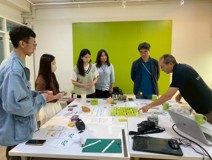
Building on the previous analysis, students design the game rules, card types, and operational conditions. This process translates abstract landscape changes into concrete, operable game mechanics, allowing the choices of different roles to produce observable spatial outcomes.
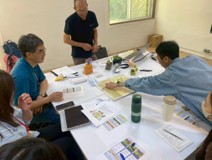
Step 4: Game Play, Testing, and Refinement
Through multiple rounds of playtesting and process documentation, students evaluate whether the game effectively represents the logic and complexity of landscape changes. Based on their observations, they adjust rules and parameters to make the game more closely reflect real-world conditions.
Step 5: Feedback on Landscape Management and Governance
Finally, students consolidate the data accumulated during gameplay to analyze landscape development trends under different strategic combinations. They then formulate concrete management and governance objectives and propose strategic recommendations, addressing the decision-making needs of the real-world site.
Teaching Outcomes and Extended Value
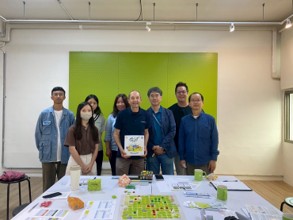
The course culminated in the design of the “Board Game on Landscape Changes along the Resumed Yilan Forest Railway Corridor,” accompanied by an operations manual and a final integrative report, forming a foundation for subsequent teaching and dissemination. These outcomes not only helped students develop a systematic understanding of landscape governance but also demonstrated the role that design education can play in analyzing and communicating public issues.
Through game-based operations, students repeatedly test hypotheses, comprehend conflicts, and consider trade-offs, learning how to make flexible and socially responsible planning judgments in the face of uncertain landscape transformations.
The landscape is not a finished product but an ongoing negotiation. This course enabled students, before engaging in design, to first understand and operate within dynamic change, observing the interplay between people, institutions, and space.
Text: Professor Chen-Ting Wu / Images: Professor Chen-Ting Wu
#Chung Yuan Christian University, Department of Landscape Architecture
#Chung Yuan Christian University, Department of Landscape Architecture, Master’s Program