Graduate Student Section
中原大學地景建築系 CYCU LANDSCAPE ARCHITECTURE
中原大學地景建築系
CYCU LANDSCAPE ARCHITECTURE
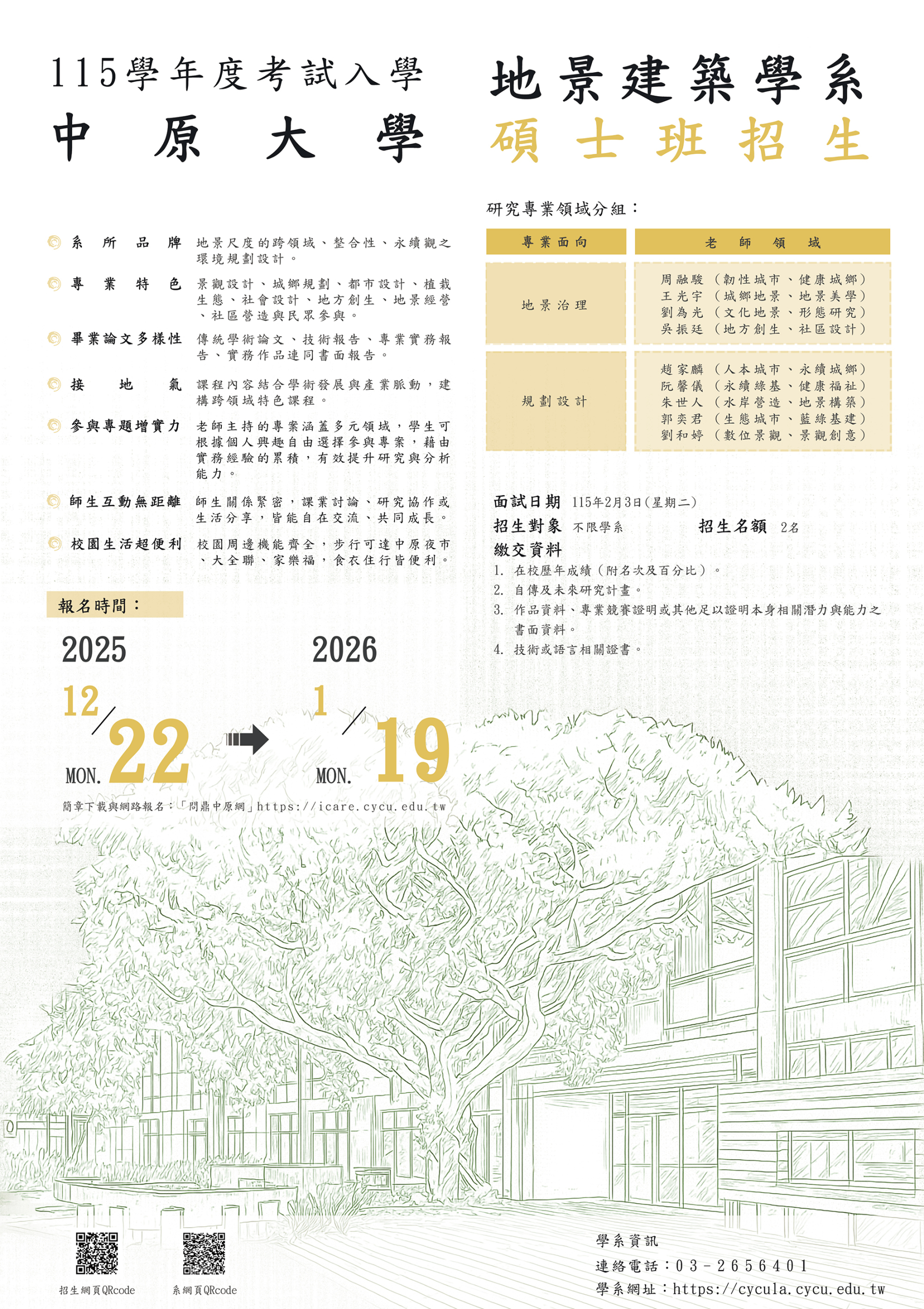
✨ Department Brand: Landscape-Scale Interdisciplinary, Integrated, and Sustainable Environmental Planning and Design.
✨ Key Areas of Expertise:Landscape Architecture, Urban and Rural Planning, Urban Design, Planting Ecology, Social Design, Regional Revitalization, Landscape Management, Community Development, and Public Participation.
✨ Thesis Format Diversity:Traditional academic theses, technical reports, professional practice reports, and practical projects accompanied by written documentation.
✨ Practice-Oriented and Interdisciplinary:The curriculum integrates academic development with industry trends, offering interdisciplinary courses that reflect real-world needs.
✨ Project-Based Learning for Skill Enhancement:Faculty-led projects span diverse fields, allowing students to choose topics based on their individual interests. Through hands-on involvement, students effectively strengthen their research and analytical skills.
✨ Close Faculty-Student Interaction:The program fosters strong and supportive relationships between faculty and students, encouraging open communication in academic discussions, research collaboration, and personal growth.
✨ Convenient Campus Life:The campus is surrounded by well-developed amenities. Within walking distance are the Zhongyuan Night Market, PX Mart, and Carrefour, providing easy access to food, shopping, and daily necessities.
The vision and educational objectives of the Master’s program are to cultivate professionals in interdisciplinary planning and design, landscape-scale analysis, and landscape environmental management. This aims to establish students’ design research capabilities and literacy; foster innovative thinking, teamwork, and problem-solving skills; and develop expertise in landscape architecture and technical application.
The research specializations of our full-time faculty span two major domains: “Landscape Governance” and “Planning and Design.” Combining academic rigor with practical expertise, our curriculum centers on courses related to these two fields. We provide a comprehensive knowledge system supporting advanced studies in landscape architecture and are committed to fostering interdisciplinary research exchange and collaboration.
| Research Specialization Grouping | Landscape Governance | Planning and Design |
|---|---|---|
| Teacher – Field of Expertise | 周融駿 – 韌性城市、健康城鄉 王光宇 – 城鄉地景、地景美學 劉為光 – 文化地景、形態研究 吳振廷 – 地方創生、社區設計 | 趙家麟 – 人本城市、永續城鄉 阮馨儀 – 永續綠基、健康福祉 朱世人 – 水岸營造、地景構築 郭奕君 – 生態城市、藍綠基建 劉和婷 – 數位景觀、景觀創意 |
⏰ Online Registration: From Monday, December 22, 2025 to Monday, January 19, 2026, until 12:00
ℹ️ Admissions Information (including application website and admissions brochure): https://icare.cycu.edu.tw/modules/signup/
👍 The department flexibly adapts course content to align with students’ interests and backgrounds, enabling each student to identify their own learning focus. We encourage students to explore the potential applications of landscape architecture with a high degree of curiosity, rediscovering the interwoven relationship between people and landscapes within the discipline.
✨ Department Brand: Landscape-Scale Interdisciplinary, Integrated, and Sustainable Environmental Planning and Design.
✨ Key Areas of Expertise:Landscape Architecture, Urban and Rural Planning, Urban Design, Planting Ecology, Social Design, Regional Revitalization, Landscape Management, Community Development, and Public Participation.
✨ Thesis Format Diversity:Traditional academic theses, technical reports, professional practice reports, and practical projects accompanied by written documentation.
✨ Practice-Oriented and Interdisciplinary:The curriculum integrates academic development with industry trends, offering interdisciplinary courses that reflect real-world needs.
✨ Project-Based Learning for Skill Enhancement:Faculty-led projects span diverse fields, allowing students to choose topics based on their individual interests. Through hands-on involvement, students effectively strengthen their research and analytical skills.
✨ Close Faculty-Student Interaction:The program fosters strong and supportive relationships between faculty and students, encouraging open communication in academic discussions, research collaboration, and personal growth.
✨ Convenient Campus Life:The campus is surrounded by well-developed amenities. Within walking distance are the Zhongyuan Night Market, PX Mart, and Carrefour, providing easy access to food, shopping, and daily necessities.
This is the Department of Landscape Architecture at Chung Yuan Christian University — ever evolving, ever growing.
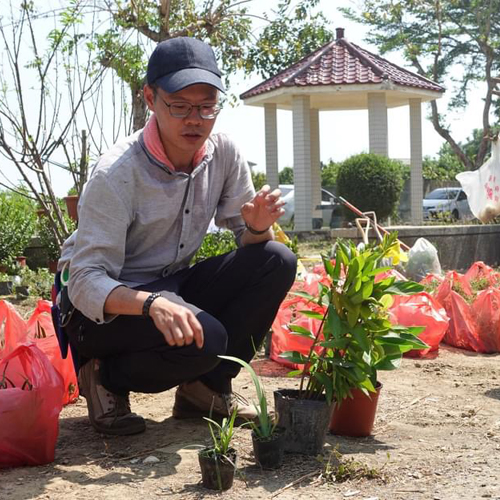
“Hold this clearly in your mind: what is drawn on those plans are not merely lines, but relationships, power, and economy; what is erased is not simply a patch of color, but context, needs, and culture. Only then does one begin to touch the edge of the landscape, and perhaps find a fitting place to stand—as a professional who works earnestly for the environment in their own way.”
This, I would say, is the understanding that the Landscape Architecture master’s program at Chung Yuan has given me.
Professional education at the undergraduate level is like viewing mountains from afar: you see many scenes, yet have not stepped onto a single trail. Most schools require you to choose which mountain to climb the moment you enroll—but how could you know whether the view atop it is the very landscape you seek?
The master’s program at Chung Yuan, however, gives us reassurance: it lets us first learn about different kinds of mountaineering gear, explore possible encounters ahead, and understand that the entry paths into the mountains come in many forms—so we may choose carefully, and walk the mountain we truly wish to climb.
This mountain that belongs to oneself is slowly pieced together through actions, literature, and drawings. And once you begin to tread it in earnest, the landscape you gain is something no one else can take away.
Come—let us walk and see together.
Written on December 5, 2025
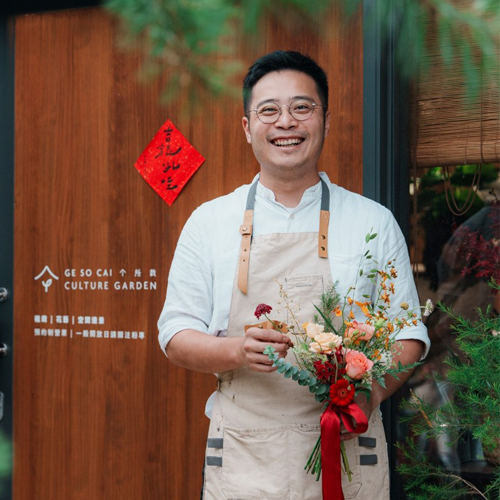
The four years of university are a crucial period for exploring oneself and shaping one’s direction in life. Throughout this journey, many of us begin to think about the paths we wish to take in the future. At the Department of Landscape Architecture at Chung Yuan Christian University, our professors often led us into mountains and coastal areas, into communities and various field sites, allowing us to experience design through the relationships between people and the land. In fact, without realizing it, we were already taking our first steps into the world of professional practice.
Looking back, I have always enjoyed observing the people and things around me—growing plants, chatting with others, visiting markets, organizing my room. These seemingly ordinary habits quietly nurtured my sense of aesthetics and my ability to observe. Not until I entered graduate school did I fully understand that “landscape design” is not limited to planting plans or the layout of outdoor spaces; rather, it is an integrative way of thinking that extends into all aspects of life. It can take the form of floral design, curating themed markets, redesigning a small shop, or selecting soft furnishings. As long as one has a clear grasp of spatial qualities and confidence in one’s abilities, the possibilities of applying what we have learned are limitless.
Today, I have established Yu Chuan Design Integration Co., Ltd. While design is at the core of our work, our most essential strength lies in integration. This is the greatest lesson I gained from the CYCU Landscape Architecture graduate program—that landscape design is not merely drawings and lines, but the ability to communicate, coordinate, and connect resources across different fields. With effective communication and integration, we can create better outcomes not only in the workplace, but also in communities and in everyday life.
I warmly welcome you to join the Graduate Institute of Landscape Architecture at Chung Yuan Christian University. You will discover that landscape is more than spatial design—it is a diverse practice rooted in daily life, connecting people and the environment.
Written on November 3, 2025

Fullmetal Alchemist is an anime series that I deeply love, and it is widely regarded as a modern masterpiece of the art form. The story follows the Elric brothers on their journey to recover what they lost—their own bodies. Alchemy in this universe allows the transmutation and shaping of matter, based on the fundamental principle of “comprehension, deconstruction, and reconstruction.”
An alchemist must first observe and understand the object, then analyze and break it down to its essence, and finally, through a precisely drawn transmutation circle, reconstruct it into another imagined form.
In order to teach the brothers to truly understand the nature of things, their master left them to survive alone on a deserted island. There, among the coasts, wilderness, and forests, they learned to forage, hunt, and build shelter. Lying on the grass beneath a river of stars, they came to understand the flow of energy and the law of conservation. Watching columns of ants carry food and build nests, they realized that every tiny individual is a singular “one” within the larger landscape, and only countless “ones” can form a whole.
The thinking behind ancient alchemy later evolved into the foundations of modern science and design. Landscape architecture, as a discipline of planning and design, is no exception.
Through my studies in this field, I’ve gradually come to several important realizations:
Only through genuine field investigation can we gradually clarify and grasp the full picture of a place.
Reading and interpreting artistic works to extract their logic and structure is a foundational skill for curatorship.
The multifaceted nature of landscape architecture: landscape management is not only about spatial construction but also about building relationships.
A personal insight into the digital domain:
landscape = f(x) — the landscape as a relational function.
Written on October 2, 2025
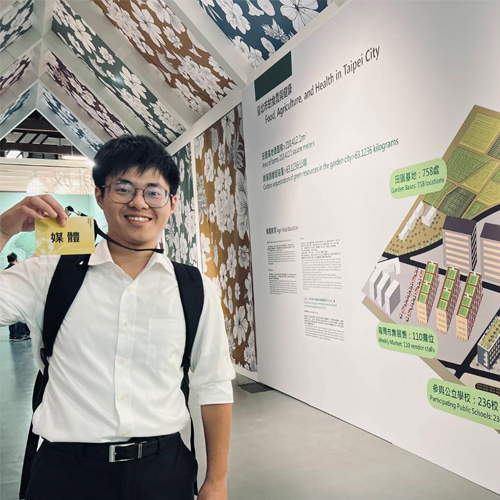
Everyone has a chapter in life that holds special meaning to them. For me, pursuing a master’s degree in Landscape Architecture at Chung Yuan Christian University has been a pivotal moment—one that opened doors to new futures and infinite possibilities.
From cities to rural villages, from Taiwan’s main island to its outlying islands; from the academic ivory tower to the social grassroots, from imagined landscapes to tangible spaces—the days I’ve spent at CYCU have been like a series of joyful journeys. Each day, I find myself walking the line between the imagined and the real, weaving through layered landscapes to uncover the never-ending performance of space on the stage of society.
From an academic perspective, landscape is a text, a language, a representation of spatial constructs. It is interaction between people, and the dynamic tension between society and environment. But for me personally, landscape is an endless adventure—and I am still moving forward on this path of exploration.
I look forward to the day when someone full of passion and hope—like you—joins us on this journey.
Written on September 24, 2025

After navigating through the complex courses of university life, I have finally arrived at an important crossroads in my life. If you enjoy observing the little things around you or have strong feelings and visions about your living environment, welcome to the Department of Landscape Architecture. Here, you will meet many professors specializing in various fields of environmental design, who will guide us to absorb abundant knowledge in design—from mastering the fundamentals at the drafting table to conducting field visits outdoors; from analyzing the historical context of environments to experiencing the rich local culture.
Along the way, your creativity and logical thinking will be constantly inspired. Many courses also offer opportunities for teamwork and communication with professors, helping us develop both collaborative skills and independent thinking. There are plenty of chances to interact with senior and junior students alike, without any barriers of age or grade.
The Department of Landscape Architecture feels like a big family, providing a supportive environment where we can study with peace of mind. The professors carefully design the curriculum to ensure students build a solid foundation in design. Although the program demands a lot of time and effort, especially in honing design skills, we are essentially planting trees for our own future.
Written on April 11, 2024

Hello! I’m a first-year master’s student in the Department of Landscape Architecture at Chung Yuan Christian University. First of all, congratulations on completing your undergraduate studies! Are you planning to continue specializing in your field, or are you considering exploring a new direction? If you’re still unsure, take a moment to read on.
People often ask me, “After studying design for four years and staying up countless nights, why do you still want to continue?” Although it was physically and mentally exhausting at times, looking back at the results makes it all worthwhile. If you ask me whether it’s tiring, I’d definitely say yes—but it’s also fulfilling.
Entering the master’s program feels very different. Many things require you to seek out solutions on your own. Professors become more like your assistants, and you encounter many new challenges, viewing and handling them from different perspectives. For example, before, I used to express my ideas on paper or through digital programs, but in the Chung Yuan Landscape Architecture master’s program, you might have to engage with local communities. Their needs might be completely different from what you expect—how do you adapt your designs and come up with the best solutions?
What I’ve gained most from this program is the ability to approach things and problems from multiple angles, learning how to handle them in the best possible way. It’s also a chance to see how your approach differs from others’, gaining valuable insights along the way.
Come join the master’s program in Landscape Architecture at Chung Yuan University, and open yourself up to new perspectives and fresh ways of seeing the world.
Written on April 11, 2024

Having gone through various stages of education—from undergraduate to graduate studies—it has been a journey of self-discipline and growth. Pursuing further studies is about cultivating the ability to take greater responsibility for oneself; it is definitely not an escape from stepping into the wider world.
Although many people, places, and things around you may feel unfamiliar, and the fear of struggling to adapt in a new environment can be overwhelming, it’s natural to feel uncertain about your interests when encountering things you’ve never experienced before.
When I first entered the Department of Landscape Architecture at Chung Yuan Christian University, I, too, had many doubts about my choice. However, reality proved those worries unnecessary. In this big family called Landscape Architecture, there arises a genuine confidence that encourages you to try your best.
Whether it’s the encouragement from dedicated professors, the collaborative learning atmosphere among students, or the support and care provided by the department office, you truly feel these motivations in Chung Yuan’s Landscape Architecture program. With this support, we master’s students stay passionate and driven to develop our skills and unlock our potential. This journey is not only about academic progress but also about becoming a planner full of vision and hope for the future.
Written on April 11, 2024